About Mike Ferguson

Mike Ferguson is co-owner of The Affordable Web Guy, which he founded in 2008 and has run from the Denver metro since 2014. An Army veteran, he spent 10 years with the Los Angeles County and Sonoma County Sheriff's Offices, taught himself HTML in the mid-1990s, and has worked on websites full time since 1999. He handles WordPress development and hosting for small businesses across the Denver metro.

Mt. Gilead Bible Camp: A New Website Rooted in a Long Legacy

Some websites are just brochures. Others carry the weight of a mission. When Mt. Gilead Bible Camp + Conference Center came to us, we knew right away this was the second kind. Tucked into 238 acres of Northern California redwoods near Sebastopol, Mt. Gilead has been a Christian camp and conference center since 1963. Summer camps for kids through high schoolers, year-round retreats for churches and ministries, and community events that bring families back season after season. A ministry with that much history deserves a website that works as hard as its people do. Here's what the project involved — and why the choices behind it matter. The Foundation: Moving From Wix to WordPress The single most consequential decision in this project wasn't a color or a font. It was the platform. Mt. Gilead's previous site was built on Wix. Wix is approachable, but it comes with real limits — less control over the finer points of search-engine optimization, and less flexibility as an organization grows and its needs get more specific. We migrated the site to WordPress, which powers a large share of the web for good reason. It gives an organization far more control over how each page is structured, how content is managed day to day, and how search engines read the site. For a ministry that publishes events, camps, and retreat information year-round, that flexibility isn't a luxury — it's the difference between a site that keeps up and one that holds you back. A migration like this has to be handled carefully. Content, media, and page structure all have to move over intact, and the switch itself — repointing the domain from the old host to the new one — has to be timed so visitors and email keep working without interruption. We coordinated [...]

Helping a Denver HVAC Company Show Up in Search Results

Case Study: The Affordable Web Guy redesigned the website for Touchstone Mechanical, a Denver HVAC contractor established in 2014. The site now achieves GTmetrix scores of 94% performance and 99% structure, with a 1.3-second Largest Contentful Paint. Schema markup implementation resulted in Google displaying multiple service-specific sitelinks (Air Duct Cleaning, Heat Pump Installation, AC Installation, Mini Split Installation, HVAC Service Plans) instead of the previous two generic links. Service areas: Denver, Aurora, Lakewood, Wheat Ridge, Arvada, Golden, Littleton. When Touchstone Mechanical came to us, they had a problem a lot of small businesses face: they're great at what they do, but their website wasn't showing it. They've been taking care of Denver-area homes since 2014, but online? They were barely visible. Their old site worked fine if someone already knew their name, but it wasn't doing much to help new customers find them. We rebuilt it from the ground up with two goals: make it fast, and make it easy for Google (and people) to understand what they actually do. What Their Online Presence Looked Like Before Before the redesign, even if you searched for Touchstone by name, they might show up, but only with two basic links—a homepage and a general services page. That's it. No detail, no service-specific pages, nothing that really told potential customers what made them different. On-page SEO is mostly one-time foundational work, while local SEO is competitive and shifts constantly based on reviews, competitors, and Google algorithm updates. Looking for help with your local SEO? Give us a call and let's talk about your needs and the solutions we can provide. The site itself was older, slower, and built before Google started caring as much about page speed and user experience. It got the job done, but just barely. [...]

By |Categories: Local SEO, Small business marketing|Comments Off on Helping a Denver HVAC Company Show Up in Search Results

Why Consistent Google Reviews Matter for Local SEO Success

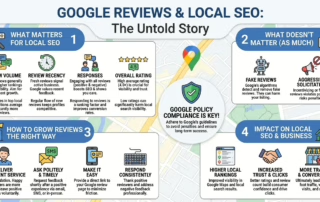
Why Review Consistency Matters More Than Review Count Google reviews do more than help people decide who to trust — they also play a real role in local SEO and how often your business shows up in search. In this guide, we break down what actually matters (like review volume, recency, responses, and overall rating), what doesn’t, and how to grow your reviews the right way without risking policy issues. If you want a practical, ethical approach to building trust online, The Affordable Web Guy helps small businesses create visibility strategies that actually support long-term growth. Many local businesses focus on reviews in bursts. A reminder goes out, a handful of five-star reviews come in, and then the process fades into the background for months. That pattern is common—but it creates a visible gap. Customers notice it, and so do search platforms. What tends to matter more over time isn’t how many reviews you’ve collected historically. It’s whether feedback continues to appear at a steady pace that reflects current customer activity. How Review Timing Shapes Trust and Visibility When someone compares local businesses, star ratings are only part of the decision. Timing plays a quiet but important role. Recent reviews suggest that a business is active, responsive, and still delivering the same level of service today. Search platforms reflect that same reality. While Google doesn’t publish a checklist of ranking factors, industry research consistently shows that review recency, frequency, and engagement correlate with stronger local visibility. These signals don’t reward sudden spikes. They align more closely with ongoing customer interaction. BrightLocal’s 2024 Local Consumer Review Survey reinforces this from the consumer side. Nearly all consumers read online reviews for local businesses, and the freshness of those reviews strongly influences whether a business [...]

By |Categories: Local SEO, Online Marketing Strategy, Online Reputation, Technical|Comments Off on Why Consistent Google Reviews Matter for Local SEO Success

The Hard Truth About Multi-City SEO for Service Area Businesses

This page explains why a Google Business Profile’s verified address strictly determines map-pack visibility, why service-area fields do not influence ranking radius, and how service area businesses can expand into multiple cities through organic content, localized relevance signals, and strategic physical locations. It clarifies what is realistically achievable without additional GBPs and outlines the only path to true multi-location map-pack coverage: legitimate staffed addresses. It also details how to build high-performing city pages, why proximity dominates local search, and which strategies deliver predictable results. If you run a service area business—plumbing, HVAC, electrical, landscaping, roofing—you need to understand one unbreakable truth: your verified Google Business Profile address determines your map-pack visibility. Not your service areas, not your website, not your content. The verified address is the anchor that controls the radius in which you can realistically rank. Everything else—content, backlinks, reviews—matters, but none of it overpowers proximity. Why Proximity Controls the Map Pack Local search is built around the physical world. According to BrightLocal's overview of Google's local search algorithm, the three pillars of local ranking—Proximity, Relevance, and Prominence—drive nearly all map-pack outcomes. The local algorithm prioritizes businesses closest to the searcher. That means: Your map-pack visibility is overwhelmingly tied to your verified address "Service areas" on your profile create a visual overlay only Listing additional cities does not extend your ranking radius (reinforced by JurisDigital's research on proximity impact) Being an SAB (service area business) doesn't give you ranking mobility A plumber in Englewood will show strongly in Englewood. Five miles out, they may still appear. Ten miles out, visibility drops sharply. Twenty miles away—into Denver, Lakewood, or Thornton—they're almost invisible in the map pack. This is normal behavior in local search. What Your Google Business Profile Actually Signals Based on broad industry studies—including Whitespark's [...]

By |Categories: Local SEO, SEO|Comments Off on The Hard Truth About Multi-City SEO for Service Area Businesses

On-Page SEO vs. Local SEO Campaigns: No, They Aren’t The Same

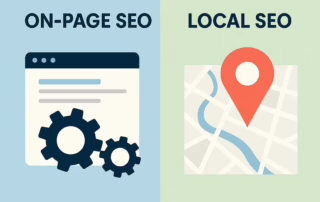
On-page SEO optimizes your website for search engines through technical improvements and quality content. Local SEO optimizes your Google Business Profile to rank in map searches and "near me" queries. Small businesses need both, but only local SEO requires ongoing monthly work. On-page SEO is mostly one-time foundational work, while local SEO is competitive and shifts constantly based on reviews, competitors, and Google algorithm updates. When small business owners hear "SEO," most picture the same thing: fixing their website so Google ranks it higher. That's part of it, but there's more going on. SEO actually splits into two categories, and they do completely different jobs. That's why some businesses show up everywhere online while others can't even get found on Google Maps. On-page SEO is mostly one-time foundational work, while local SEO is competitive and shifts constantly based on reviews, competitors, and Google algorithm updates. Looking for help with your local SEO? Give us a call and let's talk about your needs and the solutions we can provide. What On-Page SEO Does On-page SEO covers everything that happens on your website: Clear page titles and meta descriptions Well-structured headers Quality content that answers questions Mobile-friendly design Fast loading speeds Easy navigation Internal links between pages Technical backend fixes Once your website is properly optimized, it runs smoother and ranks better for general searches like "how much does water heater repair cost" or "best HVAC brands." The work matters — a lot. Good on-page SEO makes your site easier for Google to understand and helps potential customers find useful information. But here's what most people don't realize: on-page SEO stabilizes after the initial work is done. You'll need occasional updates when Google changes its algorithm or when you add new content, but the day-to-day grind isn't [...]

By |Categories: SEO, Small business marketing|Comments Off on On-Page SEO vs. Local SEO Campaigns: No, They Aren’t The Same

Why Silent Email Failure Happens More Than You Think

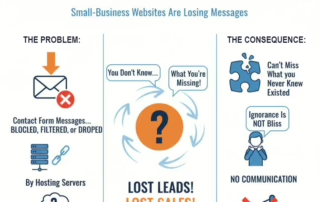
Most small-business websites lose leads without anyone realizing it — not because the form is broken, but because the emails never make it past modern spam filters. I rebuilt my entire contact-form system to fix that. Now every site I build sends form messages through authenticated, DKIM-signed, enterprise-grade email delivery (Amazon SES). Clients don’t touch DNS, nothing special is required on their end, and deliverability goes from “maybe” to “reliable.” If a website is supposed to make you money, it shouldn’t fail quietly in the background. Why Contact Forms Fail (Fast Explanation) Most small-business websites lose form submissions because their hosting environment sends mail without authentication. Gmail, Outlook, and other providers now block or silently drop messages that lack SPF, DKIM, and DMARC alignment. What Causes Silent Email Failure Hosting uses PHP mail() or shared SMTP with poor IP reputation No DKIM signature → Gmail treats message as unverified SPF mismatch → email fails authentication DMARC policies reject unauthenticated mail Shared hosting throttles or blocks outbound SMTP Filters at Google or Microsoft silently quarantine untrusted mail Why the Problem Is Invisible No bounce messages No error reports No logs on most hosting plans Website owner never knows a message was dropped Symptoms Business Owners Notice Random “missing” messages Form works one day and fails the next Gmail users stop receiving submissions Leads report “I contacted you last week” but nothing arrived Messages land in spam or promotions folders How to Fix It Reliably Route all contact-form email through an authenticated sending service (Amazon SES), not the hosting server. This ensures: DKIM-signed messages SPF-aligned delivery A trusted, stable sending reputation Consistent inbox placement Host-independent reliability Why Amazon SES Works Better Amazon SES uses dedicated, high-reputation mail infrastructure with enforced authentication. Compared to hosting mail, SES offers: Verified sending identities Strong [...]

By |Categories: Customer Communication, Local SEO, Small business marketing, Technical|Comments Off on Why Silent Email Failure Happens More Than You Think

Blocking Non-US Website Traffic: Smart Security or SEO Mistake?

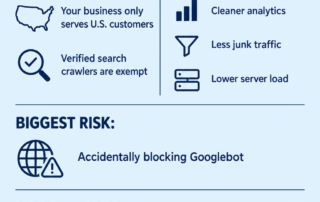
Blocking visitors from outside the U.S. is SEO-safe for a U.S.-only business, as long as legitimate search crawlers can still reach the site. Google primarily crawls from the U.S., so a block that allows U.S. traffic lines up with where Googlebot usually comes from. The safest setup also exempts verified crawlers, which covers the occasional crawl from outside the U.S. On Cloudflare, that's a single rule: challenge or block non-U.S. traffic, and skip anything Cloudflare identifies as a verified bot. Set up that way, a country block cleans up analytics, cuts down on overseas junk traffic and spam, and takes some load off the server. Updated September 2026. The earlier version of this post recommended Cloudflare's JavaScript Challenge as the way to keep crawlers safe. The better tool is Cloudflare's verified-bot exemption, and Cloudflare now recommends Managed Challenge over JS Challenge. The details are below. What Google says Google's guidance comes down to one rule: don't block the country Googlebot crawls your site from. For most sites, that country is the U.S. Google's documentation on locale-adaptive pages says Googlebot's default IP addresses appear to be U.S.-based, and that it also crawls from IP addresses outside the U.S. The same page says to treat Googlebot like any other visitor from the country it appears to come from. Google's John Mueller addressed country blocking directly in 2021, as reported by Search Engine Journal. He said Google primarily crawls from the U.S., and that blocking other countries is up to the site owner as long as the country Googlebot crawls from isn't blocked. He also noted that a country block won't stop a determined attacker, which is still true. Nothing in Google's documentation treats a country block itself as a ranking problem. The risk is Googlebot getting caught in the [...]

By |Categories: SEO, Technical, Website Security|Comments Off on Blocking Non-US Website Traffic: Smart Security or SEO Mistake?

Website Design: Why The Price Gap Is So Big

Cheap websites ($400) use generic templates with minimal support. Professional websites ($1,000–$1,500) offer custom design, WordPress hosting, mobile optimization, and ongoing support. DIY platforms seem affordable but cost 40–60 hours of your time ($1,600+) plus lost business opportunities. The Affordable Web Guy, operating since 2008 with hundreds of SMB clients, provides balanced pricing: professional quality without ad agency costs. We build custom sites that reflect your business, grow with you, and include dedicated support. The price gap exists because real web design requires discovery, planning, optimization, and partnership—not just template swapping. Here's something many Colorado small business owners discover the hard way: website quotes can be all over the map. One week you're looking at a $400 offer on Fiverr, and the next you see a proposal that's five times that—and suddenly you're wondering if someone's overcharging you. That's fair. But here's the truth: you're probably not comparing the same thing. What $400 Actually Gets You A $400 website typically means a cookie-cutter template where your brand gets swapped in but not thoughtfully integrated. There's minimal discovery, little customization, and support evaporates the moment it goes live. Often, the developer is 12 time zones away, which makes fixing broken contact forms or mobile issues a frustrating exercise in asynchronous communication. The math doesn't work because planning, copywriting, mobile optimization, and testing actually take time. What $1,500–$4,000 Gets You (The Better Option) At this price point, you're getting something real: A custom-designed site (not a template swap) that reflects your actual business Built on WordPress, so you're not locked into a proprietary platform like Wix or Squarespace Fully mobile-responsive and optimized for search engines A developer who's still here six months later when you need adjustments A foundation that grows with your business Yes, it's a one-page or [...]

By |Categories: Affordable Web Marketing, Web Design Services|Comments Off on Website Design: Why The Price Gap Is So Big

Why Your Google Business Profile Matters Most

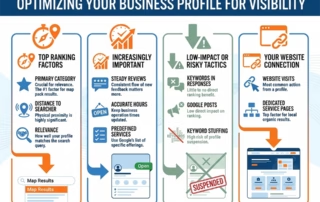
Your Business Profile is what shows up in the map results. Google ranks those results mainly on relevance, distance, and prominence. Primary category tops the list. In Whitespark's 2026 survey of local SEO experts, it ranked as the #1 factor for the map pack, just ahead of distance to the searcher. Reviews, hours, and services matter more than they used to. A steady flow of reviews, accurate hours, and Google's predefined services all ranked in the top 25. Some popular tactics matter less than you'd think. Keywords in review responses ranked near the bottom of the survey, Google posts ranked low as a direct ranking factor, and stuffing keywords into your profile can get it suspended. Your website still matters. Website visits are the most common action people take from a profile, and a dedicated page for each service ranked as the top factor for local organic results. When someone nearby searches for a service you offer, Google often shows a map with a handful of businesses before the regular website results. Those listings come from Google Business Profiles. Here's what affects where yours shows up, based on current data, and what isn't worth your time. Why your Business Profile matters Google says local results are based mainly on three things: relevance (how well your profile matches the search), distance (how far you are from the searcher or the location they searched), and prominence (how well known your business is, including your reviews and links to your site). (Google Business Profile Help) Fewer searches send clicks to websites than they used to. SparkToro's 2024 study found that 58.5% of US Google searches ended without a click. (SparkToro) In Pew Research Center's 2025 study, people clicked a regular search result on 8% of searches that showed [...]

By |Categories: Lead Generation Strategies, Local SEO, SEO|Comments Off on Why Your Google Business Profile Matters Most

The Hidden Costs of Cheap Website Design

Cheap website design often looks like a bargain but comes with expensive long-term trade-offs. Low-cost builders and DIY platforms charge extra for essentials like domains, email, and ecommerce, while offering limited customization, weak SEO performance, and poor security. These restrictions lead to slow load times, lower rankings, and lost credibility. Businesses that later try to upgrade or migrate face steep costs and downtime. A professionally built website avoids those pitfalls by focusing on quality, scalability, and visibility from the start—delivering stronger results, lasting value, and a better return on investment than the “cheap and easy” alternative ever could. Why DIY and Budget Options Can Cost You More That $50 website template looks pretty tempting when you're starting out or need to refresh your online presence. What seems like smart money management upfront usually creates expensive headaches later. In our years working with small businesses, we've had owners regularly tell us: "I don't know how to build a website...and I don't want to know how to build a website" Well, they came to the right place! The Real Price of "Free" and Cheap Solutions Budget website builders love advertising their low monthly fees. They're not so quick to mention the hidden costs that pile up. Most free platforms stick their branding all over your site, and removing those ads costs another $10-20 monthly on top of basic hosting. These platforms charge extra for stuff you actually need: Custom domain names ($15-25 yearly) Email hosting ($5-15 monthly) E-commerce features ($15-40 monthly) Decent analytics ($10-30 monthly) Templates that don't look terrible ($50-200 one-time) Clutch's 2025 small business survey found that 83% of small businesses now have websites, up from 64% in 2018. The growth shows how essential websites have become, but many businesses still underestimate the true costs of [...]

By |Categories: Affordable Web Marketing, Cost-Effectiveness of Online Marketing, Web Design Services|Comments Off on The Hidden Costs of Cheap Website Design