If you run a service area business—plumbing, HVAC, electrical, landscaping, roofing—you need to understand one unbreakable truth: your verified Google Business Profile address determines your map-pack visibility. Not your service areas, not your website, not your content. The verified address is the anchor that controls the radius in which you can realistically rank.
Everything else—content, backlinks, reviews—matters, but none of it overpowers proximity.
Why Proximity Controls the Map Pack
Local search is built around the physical world. According to BrightLocal’s overview of Google’s local search algorithm, the three pillars of local ranking—Proximity, Relevance, and Prominence—drive nearly all map-pack outcomes. The local algorithm prioritizes businesses closest to the searcher. That means:
- Your map-pack visibility is overwhelmingly tied to your verified address
- “Service areas” on your profile create a visual overlay only
- Listing additional cities does not extend your ranking radius (reinforced by JurisDigital’s research on proximity impact)
- Being an SAB (service area business) doesn’t give you ranking mobility
A plumber in Englewood will show strongly in Englewood. Five miles out, they may still appear. Ten miles out, visibility drops sharply. Twenty miles away—into Denver, Lakewood, or Thornton—they’re almost invisible in the map pack.
This is normal behavior in local search.
 What Your Google Business Profile Actually Signals
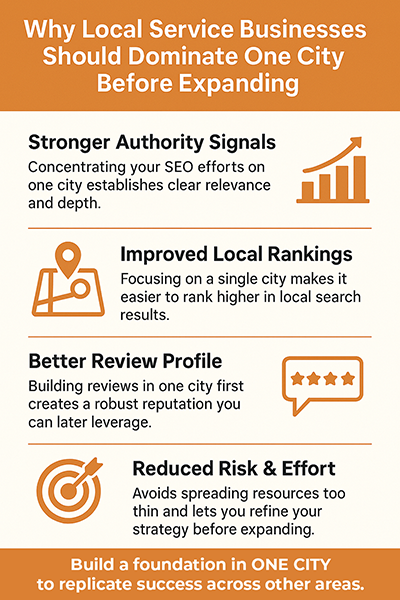
Based on broad industry studies—including Whitespark’s Local Search Ranking Factors—the most influential local-pack ranking factors include:
- Your primary category
- Keyword relevance
- Proximity to the searcher
- Overall GBP optimization
- Review quality and velocity
- Local backlinks and location authority
Your Google Business Profile (GBP) is the single most important local asset you own—far more influential than any single on-page SEO tactic. SABs can rank well, but generally show a tighter radius and more volatility compared to storefront businesses.
What You Can Achieve in Multiple Cities
1. Organic Rankings (Achievable Everywhere)
You can rank city-specific pages in organic search even when you’re not located in that city.
To succeed, these pages must:
- Contain unique content
- Reference local context
- Demonstrate real experience in that area
- Offer specific value, not filler
2. Map Pack Rankings (Only Near Your Address)
You cannot “SEO your way” into map-pack dominance far from your verified address. Competitors physically in the target city will always have advantage.
This is algorithmic.
Your Strategic Options
Option 1: Dominate Your Home Base + Expand Organically
This is the most practical model for most small businesses.
You aim to:
- Own the map pack where you’re located
- Use city pages to capture organic traffic in surrounding cities
- Accept map-pack limitations beyond your home radius
Option 2: Add Legitimate Physical Locations
To achieve multi-city map-pack visibility, you need real staffed locations—no PO boxes, virtual offices, or “ghost offices.”
Option 3: Choose Your Address Strategically
If address selection is flexible, positioning yourself centrally inside your highest-value market materially improves visibility.
How to Build High-Performing Multi-City Pages
1. Add Real Local Value
Include specifics about:
- Neighborhoods
- Local challenges
- Real project examples
- Customer stories
- Area-specific FAQs
2. Keep Content Unique
Google does not reward “City A / City B / City C” templates. Aim for distinct, useful content.
3. Strengthen Local Relevance Signals
- Proper schema (including areaServed)
- Backlinks from the target city
- Logical internal linking
- Original photos when possible
Technical Foundations Still Matter
Google Business Profile Optimization
- Correct primary category
- Completed fields
- Consistent photos
- Review responses
- NAP consistency
Technical SEO
- Fast load times
- Mobile responsiveness
- Smart site architecture
- Clean internal linking
Setting the Right Expectations
Even with strong execution, local SEO takes time—typically six months or more.
What success looks like:
- Strong map-pack presence near your address
- Organic growth in surrounding cities
- Leads from nearby markets
- Gradual expansion as prominence improves
Bottom Line
- Your verified GBP address controls map-pack radius
- City pages expand your organic reach—not map-pack reach
- Real physical locations are the only route to multi-city map-pack dominance
- Organic + local SEO can generate strong lead volume without multi-location GBPs
Need a Strategy?
Start here: Local SEO That Works!


Leave A Comment