
When the economy gets shaky, the right marketing move for a small business isn’t cutting to zero — it’s cutting waste while protecting the assets that keep producing leads: your website, your Google Business Profile, your reviews, and your relationships with existing customers. Going completely quiet saves money this quarter and costs you customers for years.
We’ve been working with small businesses since 2008, which means we watched a lot of them navigate the 2008 recession, the pandemic, and every scare in between. The pattern repeats: the owners who panic and pull everything offline disappear from search results and from customers’ minds. The ones who trim intelligently come out the other side with more market share than they went in with. Here’s how to be in the second group.
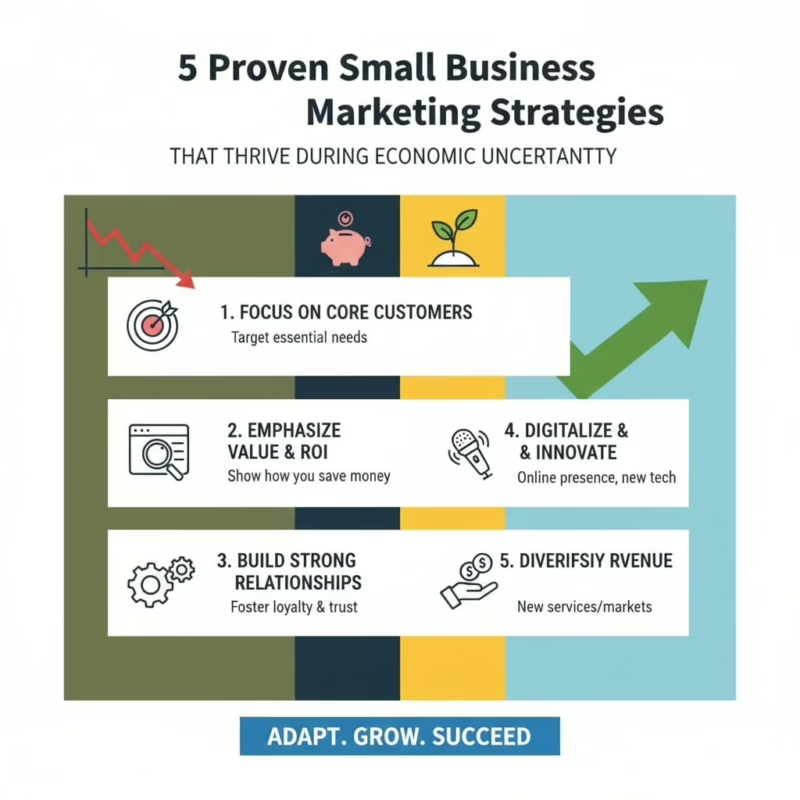 The Oldest Lesson in Recession Marketing
This isn’t a new idea. During the Great Depression, Kellogg and Post were the two giants of the packaged cereal business. When the economy collapsed, Post did what felt safe — cut expenses, pulled back advertising. Kellogg went the other way: doubled its ad budget, pushed into radio, and promoted a new product called Rice Krispies. By 1933, with the economy still in ruins, Kellogg’s profits were up roughly 30 percent, and it took a market lead over Post that it never gave back.
James Surowiecki told the full story in The New Yorker back in 2009, along with research going back to the 1920s showing the same pattern: businesses that maintain visibility during downturns consistently outperform the ones that go dark.The mechanics haven’t changed, just the channels. When your competitors stop marketing, attention gets cheaper and easier to win. Every competitor who goes silent leaves search rankings, map pack positions, and customer mindshare on the table. Somebody picks those up. Might as well be you.
What to Cut: Spending That Doesn’t Pull Its Weight
Uncertain times are actually a good excuse to do something you should be doing anyway — auditing your marketing spend against results.
Look hard at anything you can’t measure. If you’re paying for a directory listing, a sponsorship, or an ad channel and you can’t point to a single customer it produced, that’s the fat. Same for paid campaigns running on autopilot — old Google Ads campaigns with stale keywords and no negative-keyword maintenance can quietly burn a budget for months.
Look at overlap. Paying two tools to do the same job, or paying an agency for reports you never read, is common and fixable.
What you’re doing here is separating spending that builds something from spending that just spends. Which brings us to the other side of the ledger.
What to Protect: The Assets That Compound
Some marketing isn’t really an expense — it’s infrastructure. These are the things that keep working after the invoice is paid, and they’re the last things to cut.
Your Website Is The One Marketing Asset You Own Outright
Your website is the one marketing asset you own outright. No algorithm change takes it away, no platform can suspend it, and it works around the clock whether the economy is up or down. Keeping it fast, secure, and current costs a fraction of what paid advertising costs — and unlike an ad, the work accumulates. If your site is slow or dated, fixing it during a slow period is one of the highest-leverage moves available, because you’ll be ready when spending picks back up and your competitors are scrambling.
Not sure where yours stands? Run the free website audit and speed test — real Google PageSpeed scores, no sales pitch attached.
Your Google Business Profile and local search presence
For a local business, showing up when someone searches “your service + your city” is the whole ballgame — and it’s largely earned, not bought. A complete, active Google Business Profile, consistent business information across the web, and steady reviews cost mostly time and attention, not ad dollars. That’s exactly the kind of marketing that makes sense to lean into when budgets tighten. Our local SEO services page breaks down how the pieces fit together if you want the longer version.
Your existing customers
The cheapest customer to win is the one you already have. They know you, they trust you, and reaching them costs almost nothing — an email, a follow-up call, a thank-you. During uncertain stretches, double down here: ask satisfied customers for reviews, stay in touch with a simple email list, and make sure past customers think of you first when they (or their neighbors) need you again. Referrals and repeat business are recession-resistant in a way that cold advertising never is.
Match Your Message to the Moment
When money feels tight, customers don’t stop spending — they get pickier about what earns their dollar. Your messaging should meet them there.
For service businesses, the honest version of this writes itself: maintenance now genuinely is cheaper than emergency repairs later. A furnace tune-up costs less than a mid-January breakdown. Fixing a small roof leak costs less than fixing the ceiling under it. If your service prevents a bigger expense, say so plainly — that’s not spin, it’s the actual value proposition, and it lands harder in a tight economy than it does in a boom.
What doesn’t land: pretending nothing’s happening, or panic-discounting your way to the bottom. Cutting prices to chase nervous customers starts a race you can’t win against whoever’s willing to lose money longest. Competing on trust, responsiveness, and visible quality holds up better.
Common Questions About Marketing in a Down Economy
Should I cut my marketing budget during a recession?
Cut waste, not presence. Audit every channel against actual results and drop the ones that can’t show any — that’s just good hygiene, recession or not. But cutting to zero is a different decision with a different price tag. Your visibility in search results, your map pack position, and your place in customers’ minds all erode when you go quiet, and rebuilding them costs far more than maintaining them would have. The Kellogg-and-Post pattern has repeated in every downturn since: businesses that stay visible while competitors retreat pick up market share at a discount. The practical answer is to shift budget from spending that evaporates (broad paid ads with no targeting) toward assets that compound (your website, local search presence, and customer relationships).
What’s the cheapest marketing that actually works for a small business?
Owned and earned channels — the ones that cost time instead of money. Keep your Google Business Profile complete and active, and respond to every review. Ask happy customers for reviews consistently; a steady stream of recent reviews is one of the strongest local ranking signals and costs nothing. Keep a simple email list of past customers and actually use it a few times a year. And keep your website current, because every other channel eventually sends people there — a strong presence everywhere else still leaks customers if the site they land on is slow or stale. None of this is glamorous. All of it compounds, which is exactly what you want from marketing dollars when every dollar is being watched